Better decisions start with better knowledge. In the first part of our interview with consortium partners EXUS, the team leading Work Package 5 – Digitalizing the food supply chain – Early warning notification and
preparedness for crises, we explore how SecureFood is bringing together the knowledge generated across the project into practical digital services that support decision-making during food system disruptions. From the SecureFood Observatory Dashboard to the Early Warning System, the conversation highlights how integrating data, tools and expertise can help stakeholders better understand emerging risks and strengthen the resilience of Europe’s food systems.
1. To start, could you briefly explain what Work Package 5 – Digitalizing the food supply chain – Early warning notification and preparedness for crises (WP5) is about and why it is important for the SecureFood project as a whole?
Every important decision starts with information. The challenge, however, is to ensure that the right information reaches the right people at the right time. That is what WP5 is designed to achieve.
Throughout the course of the SecureFood project, our consortium partners are generating valuable knowledge; from risk assessments and resilience indicators to analytical models and policy recommendations. Yet knowledge alone does not strengthen food systems. Its value lies in helping people make better decisions.
Our role is to transform the scientific and technical results of SecureFood into practical digital services that stakeholders can actually use. At the heart of this effort is the SecureFood digital ecosystem, centred around the Observatory Platform and complemented by the Early Warning System, the Information Exchange Platform, and other interconnected digital services. Rather than asking users to navigate multiple tools, datasets or research outputs, we are bringing knowledge together in a single, integrated environment that is both accessible and meaningful.
This is especially important because food system disruptions rarely leave much time for reflection or a delayed reaction. Whether the trigger is an extreme weather event, a disease outbreak, geopolitical instability, or a breakdown in supply chains, decision-makers need timely, reliable information that helps them understand what is happening and what they should do next.
In essence, our role is to ensure that those safeguarding the resilience of our food systems have the knowledge, tools, and confidence to make informed decisions when they matter most. Ultimately, the success of WP5 will not be measured by the number of digital tools we develop, but by whether they help people respond to disruption with greater confidence and build more resilient food systems.
2. SecureFood focuses on strengthening food system resilience. What role does digitalisation play in achieving that?
Digitalisation is not simply about technology, but about helping people make better decisions.
Food systems generate enormous amounts of information every day, from weather forecasts and environmental observations to market trends, logistics data, and analytical outputs. Yet this information is often scattered across different organisations, sectors, and platforms. Looking at only one part of the picture rarely provides the understanding needed to respond effectively to emerging challenges.
That is why integration is at the core of WP5. The innovation is not that we are building another digital platform, but that we are bringing together diverse sources of information and transforming them into knowledge that supports better decision-making. By connecting data, digital services and analytical tools within a common environment, stakeholders gain a more complete understanding of evolving situations and their potential impacts.
Equally important is recognising that different users have different needs. A policymaker preparing for potential disruptions does not require exactly the same information as a food business managing its supply chain, a farmer monitoring production conditions or a researcher analysing long-term trends, and so on. The platform, therefore, provides role-based access, allowing each stakeholder to focus on the information, tools, and services that are most relevant to their responsibilities and their position within the broader, interconnected food system.
Fundamentally, digitalisation is valuable because it helps people make sense of complexity, supporting collaboration across sectors, enabling evidence-based decision-making, and ensuring that knowledge generated throughout SecureFood can be translated into practical action.
3. One of the key outputs of WP5 is the Observatory Dashboard. What will this dashboard do, and who will use it?
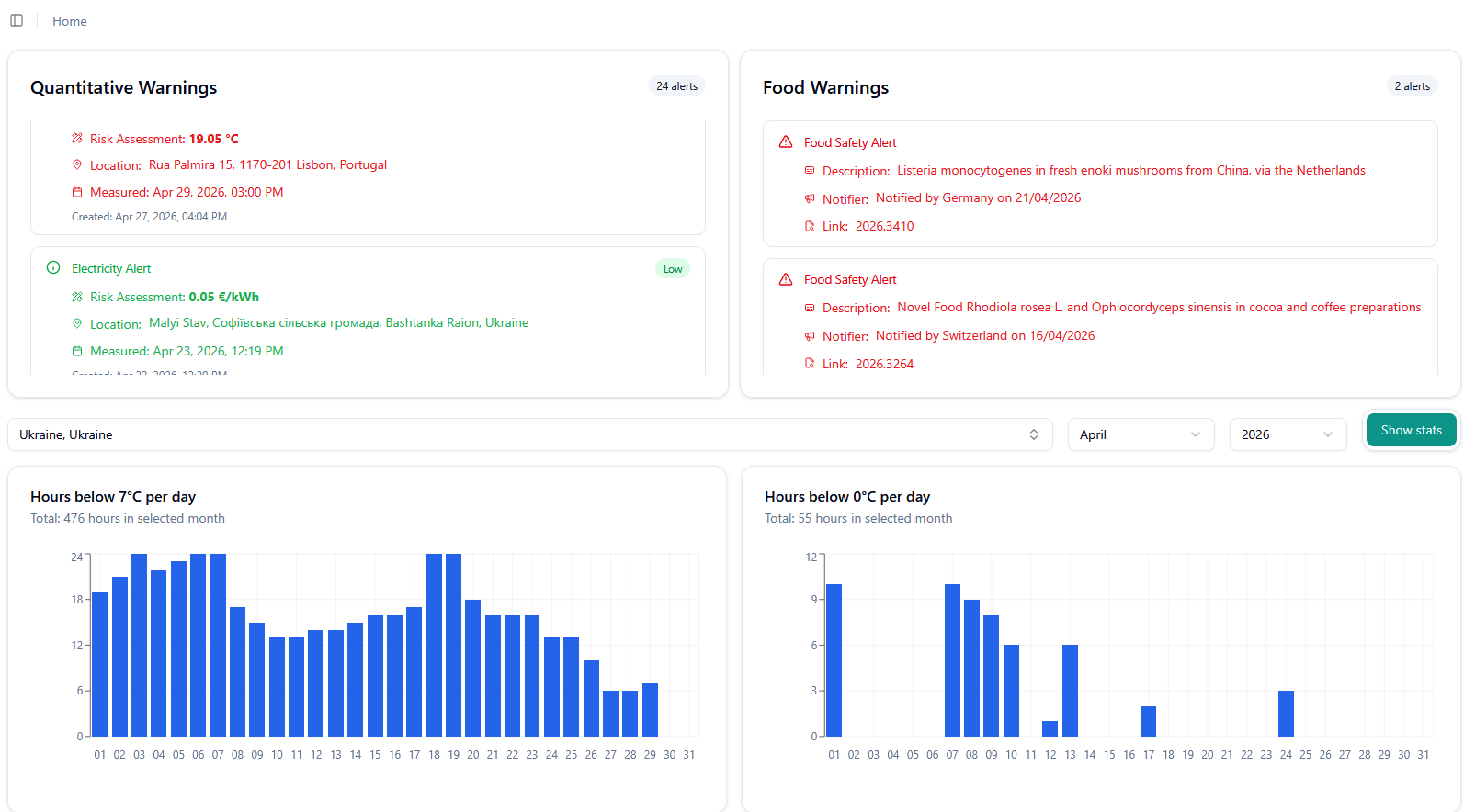
When food systems are under pressure, one of the biggest challenges is not the lack of information, but knowing where to find it and how to make sense of it. The SecureFood Observatory was designed to address exactly this challenge.
Although it is often referred to as the Observatory Dashboard, it is much more than a dashboard in the conventional sense. It is the SecureFood decision-support platform and the digital gateway to the project’s ecosystem of tools, services, and knowledge.
The Observatory brings together indicators, visualisations, decision-support services, and information developed across SecureFood into a single, integrated environment. Instead of navigating multiple platforms, reports or standalone applications, users can access relevant information through one entry point, allowing them to better understand evolving situations and support more informed decision-making.
One of the Observatory’s key strengths is its user-centred design. Different stakeholders have different responsibilities and therefore different information needs. A policymaker assessing emerging risks, a food business monitoring supply chains, a researcher analysing trends, or a public authority responding to a crisis all require different perspectives. Through role-based access, the platform provides each user with information, services, and digital tools that are relevant to their specific role.
Equally important is its flexibility. The Observatory has not been designed as a static platform that ends with the project. Instead, its architecture allows new datasets, indicators, analytical methods, and digital services to be integrated over time, ensuring that it can continue evolving as new challenges emerge and new knowledge becomes available.
The Observatory is not simply a place to view information, but a platform designed to transform complex data into actionable knowledge, helping stakeholders spend less time searching for information and more time making informed decisions.
4. WP5 is developing an Early Warning System for food security events. What kinds of risks or disruptions are you aiming to detect?
Food system disruptions rarely begin with a single event. More often, they develop gradually through a combination of signals that, when viewed together, provide an early indication that something is changing. Recognising these signals early is essential for improving preparedness and strengthening resilience.
Within the SecureFood ecosystem, the Early Warning System has been designed to support the timely identification of emerging risks that may affect food systems. Depending on the available data and the specific use case, these may include extreme weather events, environmental changes, plant and animal diseases, market instability, supply chain disruptions, and other factors with the potential to severely impact food security.
The strength of the Early Warning System lies not only in detecting potential disruptions, but also in making this information available within the wider SecureFood digital ecosystem. By working alongside the Observatory Platform and the other WP5 digital services, it contributes to a more comprehensive understanding of evolving situations, helping stakeholders access relevant information through a common decision-support environment.
One of the biggest challenges has not been to develop the technology itself, as building digital solutions is only part of the process. Equally important is identifying reliable data sources, integrating information produced in different formats and ensuring that the results are meaningful enough to support real-world decisions. This highlights the importance of collaboration across the consortium, where expertise from different partners comes together to transform diverse data into practical knowledge.
Detecting potential disruptions is not the only objective. Rather, it is to ensure that stakeholders receive reliable, actionable information early enough to understand the situation, prepare appropriate responses, and make better-informed decisions before disruption becomes crisis.

The SecureFood project is funded by the European Union’s Horizon Europe research and innovation programme under grant agreement No. 101136583. Views and opinions expressed are however those of the author(s) only and do not necessarily reflect those of the European Union or the European Research Executive Agency (REA). Neither the European Union nor the granting authority can be held responsible for them.
SecureFood social media channels:
-
- Website: https://secure-food.eu/
- LinkedIn: SecureFood
- Bluesky: @securefoodeu.bsky.social
- X: SecureFoodEU
- YouTube: @SecureFood